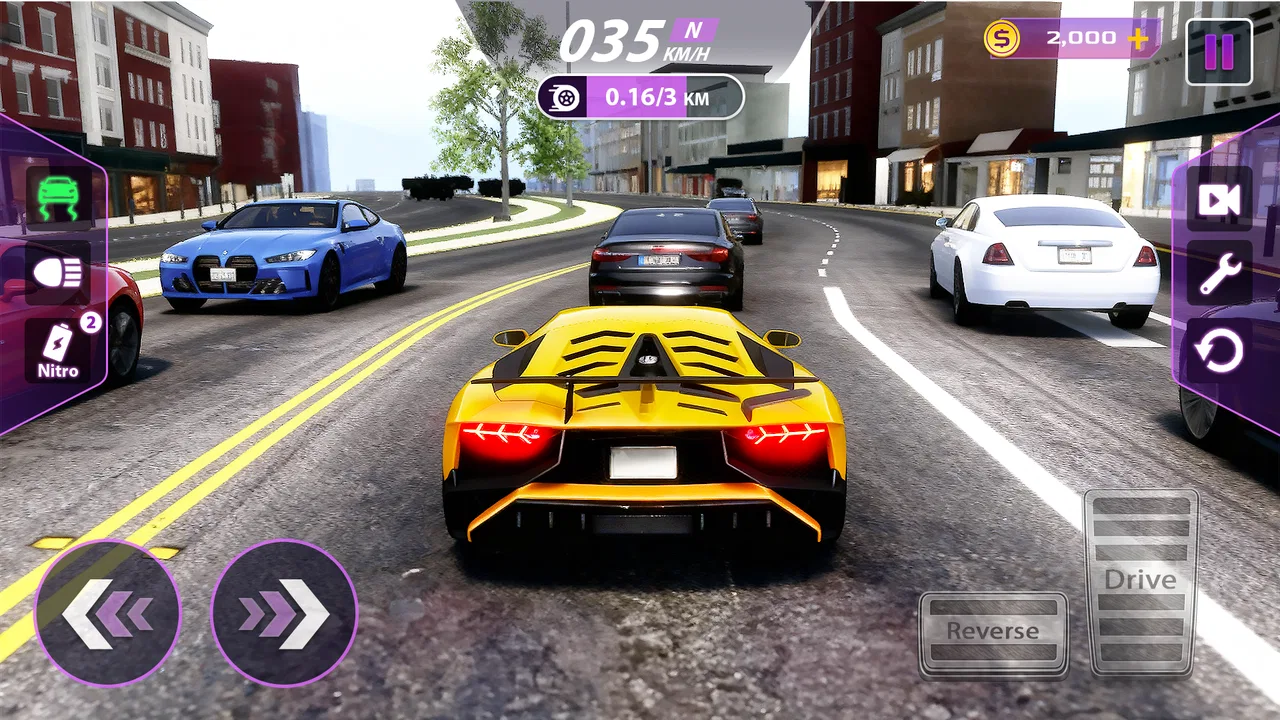
Drift Pro Car Driving
- 4.5
- Rating
- 1.00M
- Installs
- Free
- Price

 Analysis by App-foxy
Drift Pro Car Driving is the kind of racing game I open when I want immediate movement rather than a long setup. I choose a car, get into the driving, and start testing how much control I can keep while the road asks for speed and sharper turns. That simple promise gives the game an approachable first step, but the real question is whether each run creates enough feedback to make me try again. In my experience, its appeal comes from that short cycle: act, notice what went wrong, improve the next attempt, and reset before the frustration has time to settle.
Developed by Galaxy Legend Game Studio, this free racing game is aimed at a broad audience, with an Everyone content rating and support for Android 7.0 or later. It has reached over 500 thousand installs and holds a 4.2 average from around 1.2 thousand ratings, which suggests that its straightforward driving idea has found a reasonable audience. I would not approach it expecting a deep simulation or a large competitive ecosystem. I see it more as a pick-up-and-play driving experience for short breaks, casual practice, and anyone who enjoys the small satisfaction of handling a car better on the next run.
Getting Moving Without a Long Learning Curve
I find the quickest way to settle into a new racing game is to treat the opening moments as a check of how its controls respond, rather than a test of skill. A gentle first run can show whether the car’s movement feels comfortable on your device and help you decide what to adjust in your own approach. From there, it’s easier to work through the small setup checks that can make a session feel smoother.
You May Also Like

 Blood Strike: 2.5 Anniversary
Blood Strike’s Loadouts Turn Every Drop Into a Tactical Gamble
A close look at Blood Strike’s custom loadouts: how fast access to signature weapons reshapes its battle royale rhythm, rewards preparation, and narrows the gap between fights.

 Pandora - Music & Podcasts
Pandora’s Music Is Easy to Start, but Harder to Recover
Pandora’s strength is its low-effort path from a seed to a station. Its weak spot is how much confidence it asks you to place in connection, setup, and quiet recovery.

 8 Ball Pool
 Is Built on Rivalries, Rematches, and Routine
A close look at the rivalries, rematches, shared routines, and unanswered safety questions that turn a quick pool match into a persistent mobile community.

 Samsung Music
’s Quiet Strength Is Playing What You Already Own
Its reach comes less from spectacle than from dependable access to a personal library. That simplicity is both the app’s strongest retention engine and its ceiling.

 AccuWeather: Weather Radar
AccuWeather Review: A Quick, Clear Forecast for Everyday Decisions
For everyday plans, the best forecast is the one you can understand quickly. AccuWeather makes rain timing, radar, and local conditions easy to act on, with a few trade-offs.

 Hill Climb Racing
Why Hill Climb Racing Still Turns Crashes Into One More Run
A tiny car, a bumpy hill and one more upgrade: Hill Climb Racing keeps resurfacing because its simple chaos makes every near-miss feel personal.
More From Our News Desk
View All News


The first action matters more than the menu
The strongest part of the opening experience is that the game’s purpose is easy to understand before I have invested much time. The driving itself is the attraction. I am not looking for a complicated career plan or a lengthy tutorial before reaching the road; I want to feel the car respond, find the point where a turn begins to slide, and decide whether to correct or commit. That makes the first action useful even when the run is not especially successful.
For a new player, I recommend treating the first few attempts as control tests rather than races to win. Start by noticing how quickly the car reacts to steering and how much space is needed to recover from a wide turn. Trying to force a dramatic drift immediately can make the car feel unpredictable, while a calmer approach reveals the timing of the controls. This is one of the game’s less obvious strengths: a failed opening run can still teach you how aggressively the driving model wants to be handled.
The title points clearly toward drifting, but I would not assume that every turn should become a long slide. The useful distinction is between entering a corner with a plan and simply holding the control until the car loses its line. I get better results when I set up the turn early, use the slide to change direction, and then focus on straightening the car before the next demand. That small change in mindset turns the game from random swerving into a sequence of manageable decisions.
Who will feel comfortable here
This game suits players who like accessible racing controls and quick attempts. It is a good fit for someone who wants a casual driving game on an older Android device, provided that device meets the minimum operating-system requirement. It also works for players who enjoy repeating a short challenge to improve their own handling rather than needing a large story or a realistic vehicle catalogue.
I would be more cautious about recommending it to a player who wants detailed tuning, licensed cars, realistic physics, or a serious online ranking structure. Those expectations belong more naturally to a full racing simulator or a larger arcade racer. Drift Pro Car Driving is better understood as a focused driving game whose enjoyment depends on the feel of the run itself. If the act of taking a corner is not satisfying to you, extra progression would not solve the problem.
Reading the car instead of fighting it
The first useful habit is to watch the car’s position after a turn, not only the moment when the drift begins. Many players concentrate on initiating the slide and forget the exit. I find the exit more important because it determines whether the next section begins under control. A shorter drift that leaves the car aligned is usually more valuable than a spectacular slide that sends it toward the edge.
Another practical approach is to divide each run into three decisions: where to begin the turn, how much slide to allow, and when to recover. That gives the driving a repeatable structure. If I fail, I can identify which decision caused the problem instead of blaming the whole control system. This is the kind of small workflow that makes a simple racing game feel more rewarding over time.
When the controls start talking back
The feedback rhythm is built around visible consequences. A good input produces a cleaner line, a late correction costs distance or control, and an overconfident drift turns into a reset. I like that the game can communicate this without requiring a manual full of technical terms. The car’s position is the immediate feedback, and the next corner becomes the test of whether I understood it.
That rhythm is also where the game’s limitations become noticeable. Players who need highly detailed feedback may find the experience less satisfying than a more advanced racing title. A dedicated simulator can explain tire behavior, braking points, surface changes, and vehicle settings in much greater depth. Here, the lesson is more direct: the car went where I guided it, or it did not. That simplicity is useful for casual play, but it leaves less room for players who want to analyze every part of a lap.
I recommend making one change at a time when practicing. If I alter steering timing, drift length, and speed together, I cannot tell which adjustment helped. Keeping the entry consistent while changing only the exit gives a clearer comparison. This makes repeated attempts feel purposeful rather than repetitive, and it is especially helpful for players who normally abandon racing games after a few messy runs.
The reward is improvement, not just completion
The most convincing reward in this game is the feeling of a cleaner attempt. I may enter the same kind of corner, avoid the correction that ruined the previous run, and finish with a better line. That improvement is modest, but it is tangible. The game does not need to overwhelm me with systems for the basic driving loop to work; the reward arrives when an action produces a more controlled result.
At the same time, players should understand what kind of motivation they are getting. This is not the right choice if the main reason you play racing games is to collect extensive rewards, unlock a broad garage, or build a long-term competitive identity. I would choose a larger arcade racer for that. Drift Pro Car Driving is more appealing when the reward is immediate and personal: I handled that turn better than before, so I want another chance to repeat it.
A useful way to keep the reward meaningful is to set a narrow goal for each session. Instead of trying to improve everything, I might focus on avoiding unnecessary corrections or exiting corners with the car straight. That gives the run a clear purpose. It also prevents the common problem of judging the whole game by whether one attempt feels perfect.
How it fits into an ordinary day
Imagine having a few minutes before leaving for an appointment. I would not choose a game that needs a long story recap or a carefully planned multiplayer match. I could open this one, complete a handful of driving attempts, and stop after finally handling a troublesome turn. The session has a natural beginning and end because each run offers a quick test, a result, and a reason to try once more.
That same structure works after a tiring day, although I would keep expectations realistic. A casual racer can be relaxing when I accept that some attempts will be messy. It becomes less relaxing if I chase a perfect run without understanding why the car keeps drifting wide. In that situation, taking a short break is better than repeatedly making the same input and expecting a different result.
Resetting without losing the lesson
Resetting is central to the game’s appeal. A failed run does not have to feel like lost time if I can identify one useful lesson before starting again. Maybe I entered too fast, corrected too late, or stayed in the slide after the car had already pointed toward the exit. The next attempt then has a specific purpose instead of being an identical replay.
This also explains why the game may divide players. Some people enjoy a reset because it removes the consequences of a mistake and sends them straight back into action. Others may find repeated restarts thin if they want a more varied campaign or a stronger sense of progression. I fall between those views: I enjoy the reset when the driving is giving me new information, but I lose interest when a run feels interchangeable with the one before it.
My best advice is to use a reset as a diagnostic tool. After a crash or poor corner, do not immediately repeat the same approach at full confidence. Try entering more gently, release the steering earlier, or choose a safer line. Even without turning the game into a technical exercise, this makes each restart informative. It is a small but important difference between practicing and merely repeating.
Version, access, and everyday practicality
The current version is 2.0.4, and the game is free to download. That makes it easy to test without committing money first, which suits the short-session design. I would still approach the installation as a trial: play long enough to decide whether the driving feedback itself holds your attention, rather than assuming that a free racing game will provide the depth of a premium alternative.
Its Everyone rating makes it broadly suitable from a content perspective, especially for families looking for uncomplicated racing action. The more important practical question is personal preference. A younger or casual player may appreciate the direct controls, while an experienced racing fan could quickly notice the gap between this and a simulation-focused title. The same design choice that makes it approachable can also make it feel limited to someone seeking a more demanding driving model.
Where it beats the usual alternatives
Compared with a realistic simulator, this game is easier to enter and less demanding to understand. I do not need to think like a racing engineer before enjoying a corner. Compared with a large arcade racer, it can feel more focused because the basic pleasure is concentrated on driving, drifting, and trying again. That focus is valuable when I want action without managing a large collection of menus and long-term tasks.
The trade-off is variety and depth. A bigger racing game will usually offer more ways to stay interested after the initial control loop becomes familiar. A simulator will usually reward patience with more detailed handling. I would pick Drift Pro Car Driving when my priority is a quick, accessible driving session; I would choose those alternatives when progression, competition, customization, or realism matters more than immediate control.
It is also worth comparing it with endless casual racers. Those games often rely on constant forward motion and quick obstacle reactions, while this title’s identity is closer to managing the car through turns. If you enjoy planning a line and correcting your timing, that difference may make this a better fit. If you prefer reflex-heavy avoidance with little concern for corner technique, another casual racer may keep your attention longer.
The small trade-offs that shape the experience
One trade-off is precision versus accessibility. The game’s approachable nature lets me begin driving quickly, but it may not satisfy players who want every input to expose a detailed layer of vehicle behavior. Another is repetition versus mastery. Repeating a run is worthwhile when I can improve a specific decision, yet it becomes less compelling when I am looking for new environments or a broader progression path.
A third trade-off is freedom versus guidance. The direct driving loop leaves room for me to develop my own approach, but players who prefer explicit objectives and constant rewards may want clearer structure from another racing game. I see this as a matter of taste rather than a universal flaw. The important thing is to know whether you want the game to teach you through repeated handling or lead you through a larger sequence of goals.
The best way to judge Drift Pro Car Driving is to measure the quality of its next attempt, not the size of its feature list. If a failed corner makes you curious about a better entry, the loop is doing its job. If the reset only feels like returning to the same empty task, the game is unlikely to become a favorite.
My verdict after following the loop
I see Drift Pro Car Driving as a straightforward racing game with a clear reason to begin another session: the hope that the next run will be cleaner. Its action is immediate, its feedback comes through the car’s behavior, its reward is improved control, and its reset keeps the distance between failure and another attempt short. That is a coherent design, even if it does not aim for the complexity of larger racing games.
I would recommend it to casual drivers, players who enjoy drifting practice, and anyone looking for a free game that can fill a short break without demanding a long commitment. I would skip it in favor of a simulator if detailed physics are essential, or a larger arcade racer if I want extensive progression and variety. For me, the deciding factor is whether I am in the mood to refine one driving action rather than collect a whole racing career.
Galaxy Legend Game Studio has kept the appeal easy to understand: get on the road, test the turn, learn from the result, and decide whether the next attempt can be better. That loop will not suit everyone, but it gives the game a practical place on an Android device. With its broad age rating, free entry, and support for older Android versions, Drift Pro Car Driving is worth trying when accessible drifting matters more to you than simulation depth.
My final recommendation is conditional but positive. Give it a fair trial with a specific driving goal, such as improving corner exits or reducing late corrections. If that small improvement feels satisfying, the game has enough of a foundation to keep you returning. If you need a richer garage, deeper tuning, or a more elaborate racing structure, move on without guilt. The game succeeds when its compact action-and-reset cycle matches what you want from a casual racer.
FAQs for Drift Pro Car Driving
01What devices is Drift Pro Car Driving compatible with?
Drift Pro Car Driving is designed for both Android and iOS platforms. It supports a wide range of devices, ensuring compatibility with most smartphones and tablets. However, to enjoy optimal performance, it is recommended to have a device with at least 2GB of RAM and a recent operating system version.
02Does Drift Pro Car Driving require an internet connection?
Drift Pro Car Driving can be enjoyed offline, allowing you to play without a constant internet connection. However, to access certain features like leaderboards, multiplayer modes, or updates, an internet connection is needed. This flexibility makes it convenient for both online and offline gaming.
03Are there in-app purchases in Drift Pro Car Driving?
Yes, Drift Pro Car Driving includes in-app purchases. While the game is free to download, players can purchase additional cars, customization options, or progress boosters. These purchases are optional and not necessary for enjoying the core gameplay, but they can enhance the overall experience.
04What are the main features of Drift Pro Car Driving?
Drift Pro Car Driving offers a variety of features including realistic car physics, a wide selection of customizable vehicles, multiple tracks, and both single and multiplayer modes. The game focuses on delivering an authentic drifting experience with intuitive controls and stunning graphics that appeal to car enthusiasts.
05Is Drift Pro Car Driving suitable for all ages?
Drift Pro Car Driving is generally suitable for players aged 12 and up due to mild realistic driving content. Parents may want to supervise younger players, especially if they're using in-app purchases. The game promotes skill development in virtual driving and car handling, making it engaging for a broad audience.
Pros
- Realistic car physics for an immersive experience.
- Wide variety of cars to choose from.
- Intuitive controls enhance gameplay enjoyment.
- Challenging tracks keep players engaged.
- Regular updates with new features.
Cons
- Requires a stable internet connection.
- In-app purchases can be expensive.
- Some levels are locked behind a paywall.
- High battery consumption during play.
- Occasional ads disrupt gameplay.

Drift Pro Car Driving
Gallery